Legal work runs on documents. Case files, contracts, discovery materials, correspondence – they accumulate. Whether you’re building a timeline from scattered dates, searching for contradictions in witness statements, or extracting key clauses from multiple agreements, the process is often slow, meticulous, and time consuming.
In my recent Wisconsin Lawyer article, “NotebookLM for Lawyers: AI That Focuses on Your Documents”, I explore a different approach to AI in legal practice—one that focuses exclusively on your documents rather than pulling from the entire internet.
Document-Grounded AI
Most lawyers are familiar with ChatGPT, Microsoft Copilot, and similar AI tools that draw from massive datasets across the web. But when you’re analyzing case files, you often don’t want the universe of information. You need AI that works only with your specific materials—the contracts, pleadings, discovery documents, and reports in front of you.
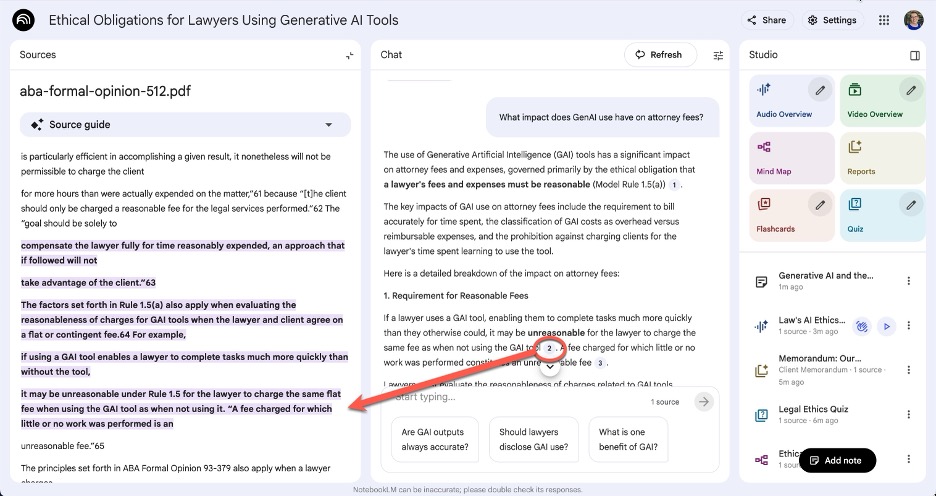
That’s what document-grounded AI does. And every answer comes with citations linking directly to specific passages in your uploaded documents. No guessing where information came from. Just focused analysis with verifiable sources.
NotebookLM
Google’s NotebookLM exemplifies this approach. It’s free, works through your browser, and accepts various file types, including PDFs, Word documents, websites, and even YouTube videos. Upload your materials, ask questions, and get answers drawn solely from what you provided—complete with clickable citations that jump you straight to the relevant text.
The article walks through practical applications like case file analysis, document comparison, client communication, and staying current with legal developments. But there’s a critical privacy consideration: the type of Google account you use determines whether you can ethically use NotebookLM for client work. Personal accounts allow human reviewers at Google to examine your uploads, making them unsuitable for confidential materials. Google Workspace accounts provide enterprise-grade privacy protections where your data isn’t reviewed or used to train AI models. The article provides detailed guidance on navigating these privacy boundaries responsibly.
See It in Action
Want to give NotebookLM a try? I’ve created an example notebook with ABA Formal Opinion 512 on Generative AI Tools already uploaded at https://go.wisc.edu/483no3. Explore the interface, test the citation feature, and check out the audio overview function—all without uploading anything yourself.